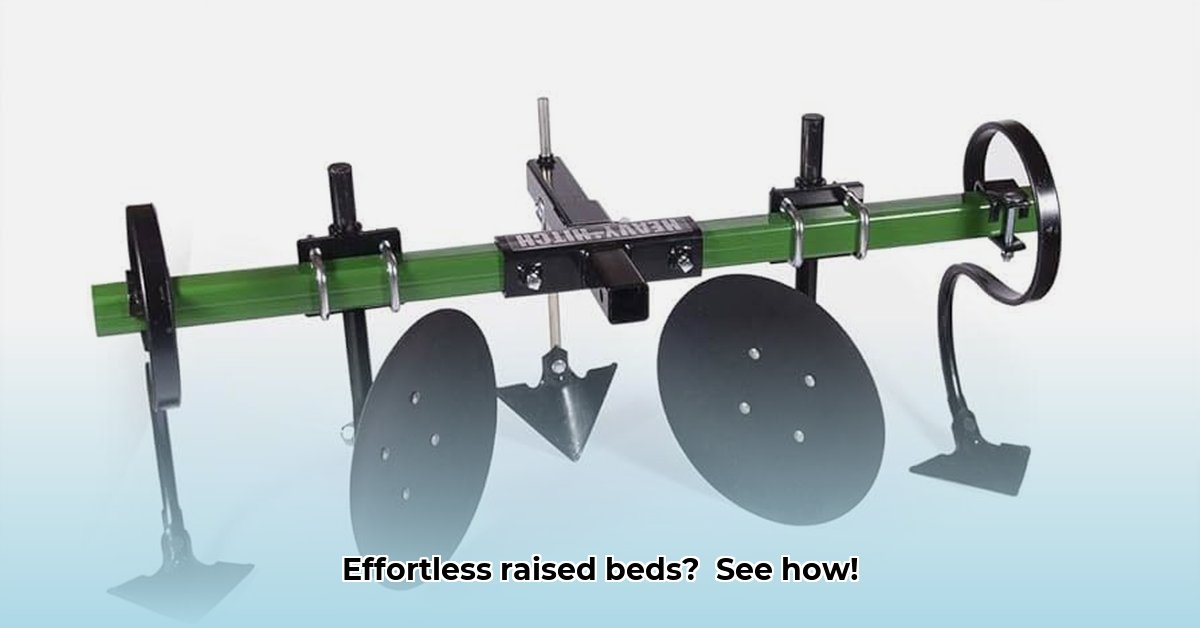
Building raised garden beds is crucial for sustainable agriculture, offering improved drainage, soil aeration, and weed control. Tractor-based attachments significantly speed up this process, making it efficient for farms of all sizes. For more Kubota tractor attachment options, check out this helpful resource. This comparative review analyzes two popular options: the Everything Attachments Garden Bedder and the Heavy Hitch Cultivator/Garden Bedder/Hiller, helping you choose the best tool for your operation.
The Everything Attachments Garden Bedder: A Customizable Approach
The Everything Attachments Garden Bedder emphasizes adaptability. Its modular design allows for modifications to suit individual needs and soil conditions. Users often add custom components, such as specialized discs or leveling bars, to tailor the attachment's performance. This flexibility is a significant advantage for farmers seeking a highly personalized solution.
Pros:
- High Adaptability: Allows for extensive customization to match specific farming styles and soil types.
- Budget-Friendly: Offers a lower initial investment than many competitors.
- User-Friendly: Relatively simple operation suitable for beginners.
Cons:
- Requires DIY Skills: Modifications necessitate mechanical aptitude and potentially additional purchases.
- Durability Questions: Long-term durability may depend on modifications and soil conditions; further testing is needed to fully assess longevity.
- Basic Out-of-the-Box Functionality: Requires supplemental additions to realize full potential.
Heavy Hitch Cultivator/Garden Bedder/Hiller: Built for Durability
The Heavy Hitch Cultivator/Garden Bedder/Hiller prioritizes robust construction. Its 2-inch receiver hitch ensures compatibility with larger tractors and its heavy-duty build promises longevity, even under demanding conditions. This attachment is designed for efficiency and longevity on a larger scale.
Pros:
- Robust Construction: Built for heavy use and a long lifespan.
- Versatile Configurations: Offers various disc configurations and compatibility with other implements, adapting to diverse soil types and farming techniques.
- High Capacity: Suitable for large-scale farming and extensive projects.
Cons:
- Higher Initial Cost: Represents a significant upfront investment compared to the Everything Attachments model.
- Potentially Overkill for Smaller Operations: May be unnecessarily powerful for smaller gardens or plots.
- Limited Compatibility: The 2-inch receiver hitch may restrict compatibility with smaller tractors.
Head-to-Head Comparison: Everything Attachments vs. Heavy Hitch
Choosing the best hiller depends heavily on individual farm needs. The following table summarizes key differences:
| Feature | Everything Attachments Garden Bedder | Heavy Hitch Cultivator/Garden Bedder/Hiller |
|---|---|---|
| Price | Lower | Higher |
| Build Quality | Moderate; user-dependent | High |
| Adjustability | High (through modifications) | Moderate |
| Versatility | Moderate (with modifications) | High (multiple configurations) |
| Ease of Use | Easy | Easy |
| Compatibility | Wide (with possible modifications) | Limited (2" receiver hitch) |
| Maintenance | Moderate | Moderate |
| Estimated Cost of Operation | Requires further research | Requires further research |
Note: Data regarding build quality, maintenance, and operational costs needs further research and field testing for accurate assessment.
The Verdict: Choosing the Right Tool for the Job
The ideal choice hinges on farm size and budget. The Everything Attachments Garden Bedder is a cost-effective option for small-scale operations and DIY-inclined farmers. Its adaptability allows for a highly personalized approach. However, larger farms prioritizing durability and a broader range of functions will likely benefit from the Heavy Hitch Cultivator/Garden Bedder/Hiller, despite its higher initial investment. A careful assessment of individual needs and soil conditions is paramount.
Actionable Steps for Choosing Your Tractor Hiller Attachment
- Assess Your Farm's Scale: Determine the size of your operation and the amount of land requiring raised bed construction.
- Define Your Budget: Establish a realistic budget for the initial investment and potential future modifications or repairs.
- Consider Soil Conditions: Evaluate your soil type and its impact on the choice of attachment.
- Check Tractor Compatibility: Ensure the chosen attachment is compatible with your tractor's hitch type and power capabilities.
- Research User Reviews: Explore online reviews and testimonials to gain insights into real-world experiences with both attachments.
- Prioritize Your Needs: Decide whether adaptability and customization or robust construction and versatility are more important.
We encourage readers to share their experiences and ask questions in the comments below. Further research and field testing are needed to fully assess the long-term performance and cost-effectiveness of both attachments.